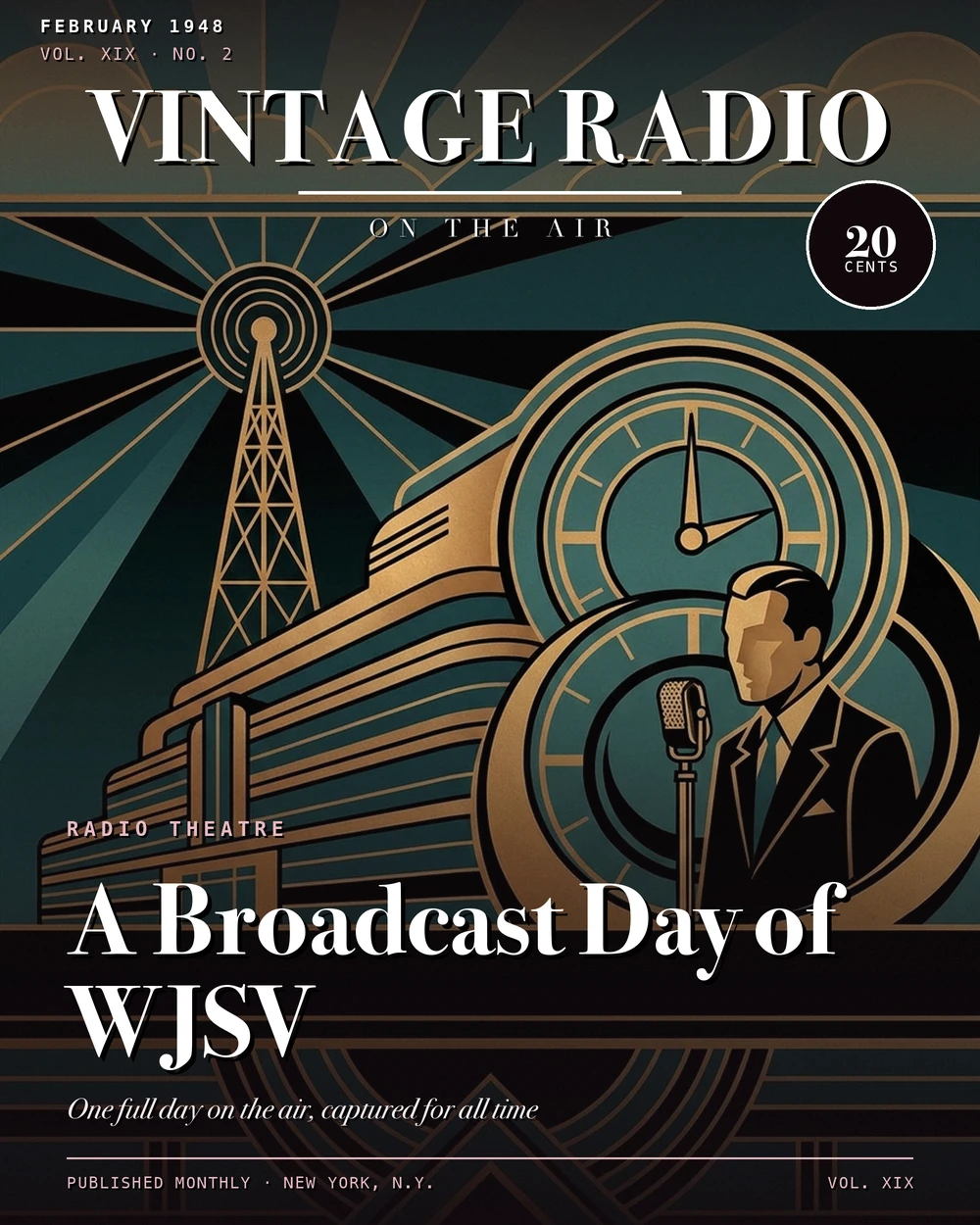
Complete Broadcast Day of WJSV
The Day Someone Recorded Everything
On September 21, 1939, for the first and only time in the Golden Age of American radio, someone recorded an entire broadcast day from sign-on to sign-off. The station was WJSV, the CBS-owned-and-operated outlet in Washington, D.C. The recording ran 19 hours — from 6:00 a.m. Eastern Standard Time through 1:00 a.m. the following morning, closing with the playing of "The Star-Spangled Banner." Nothing like it had ever been attempted before, and nothing like it survives from any other station of that era. That makes the WJSV recording not simply a curiosity but a singular document of what radio actually sounded like on a working day in the late 1930s.
The project came together through cooperation between WJSV and the National Archives. The key organizers were John Bradley, chief of the National Archives' Division of Motion Pictures and Sound Recordings, and R. D. W. Connor, the Archivist of the United States, working alongside WJSV's Ann Gillis, the station's Publicity Director, and Harry C. Butcher, CBS Vice-President in Charge of the Washington Office. The date was not chosen at random. President Franklin D. Roosevelt was scheduled to address a special joint session of Congress that day on the subject of U.S. neutrality, with war having broken out in Europe earlier that month. A speech by French Premier Édouard Daladier was also broadcast that afternoon. It was, in short, a day with genuine news weight — the kind of day that would show off what a major radio station actually did with its airtime.
Because magnetic tape recording had not yet been perfected, the audio was captured on instantaneous transcription discs — double-sided 16-inch platters, each side holding approximately fifteen minutes of audio. The original discs were donated to the National Archives, where they remained. Decades later, the recordings were added to the Library of Congress National Recording Registry as part of the 2003 class, announced in early 2004.
How the Station Got There
The station that became WJSV had a winding and at times strange history before CBS turned it into a Washington institution. It was first licensed on September 25, 1926, as WTRC, operating out of Brooklyn, New York, and connected to a front organization tied to the Ku Klux Klan. In 1927 it relocated to Mount Vernon Hills, Virginia, and rechristened itself WTFF — for The Fellowship Forum, the KKK's newspaper. In the fall of 1928, owner James S. Vance changed the call letters again, this time to his own initials: WJSV.
CBS leased the station and then purchased it outright in June 1932, resuming broadcasts on October 20 of that year. The network moved the studios from Alexandria, Virginia into Washington, D.C. proper in 1936, setting up in the Earle Building at 13th and E Streets, NW. The transmitter remained on the Mount Vernon Memorial Boulevard in Alexandria. By 1939, WJSV was a fully integrated CBS affiliate serving the capital, its earlier origins entirely behind it. The call letters would change one more time — on April 4, 1943, the station became WTOP, a name meant to reflect its position near "the top of the dial" at 1500 kHz.
During its years as WJSV, the studios hosted some notable figures. Edward R. Murrow and Walter Cronkite both passed through. Eleanor Roosevelt used the facilities for CBS radio broadcasts. Bob Trout, later a well-known network correspondent, got early experience there.
What Was Actually Broadcast
The 19-hour broadcast day covered the full range of what a major CBS affiliate offered in 1939. The morning block was presided over largely by Arthur Godfrey, hosting a program called "The Sundial." It was here that Godfrey developed the relaxed, conversational on-air manner that would later carry him to national celebrity on CBS Radio and Television — and hearing that style in its early form, against the backdrop of a Washington morning in 1939, is one of the more striking things the recordings offer.
At 8:30 a.m., John Charles Daly — who would go on to long fame as host of What's My Line? and as an ABC television news anchor — hosted a locally produced quiz program, one of his earliest quiz show appearances. The daytime hours were stacked with 18 serial dramas, all running 15 minutes each: Pretty Kitty Kelly, The Story of Myrt and Marge, Hilltop House, Big Sister, The Romance of Helen Trent, and Our Gal Sunday among them. The afternoon included a baseball broadcast — the Cleveland Indians visiting the Washington Senators in the last game of the season — with Baseball Hall of Famer Walter Johnson providing commentary.
Evening prime time brought Amos 'n' Andy, Joe E. Brown, Ask-It Basket, Strange as It Seems, and Major Bowes' Original Amateur Hour. Late night wound down with live big-band dance programs featuring the orchestras of Louis Prima, Teddy Powell, and Bob Chester. The Roosevelt address to Congress and the Daladier speech from France anchored the news programming in between. Together these elements add up to something that no programming guide or contemporary review could fully reproduce: the actual texture of the day, in sequence, as listeners experienced it.
Why It Survives and What Remains
The original transcription discs went to the National Archives following the broadcast, where they were preserved. An edition drawn directly from the National Archives discs was later produced by Joe Bevilacqua and released commercially by BearManor Media. The catalog here holds 19 episodes, divided into numbered parts from Part 01 through Part 19 — each part corresponding to one side of one of those original 16-inch platters.
No comparable complete-day recording exists for any other American radio station from this period of broadcasting. Other stations were recorded in fragments, programs survive in isolation, and individual broadcasts made it through the decades in varying states of completeness. But a continuous, sequenced, sign-on-to-sign-off document of a single day — with the news, the soap operas, the baseball, the quiz shows, the dance bands, and the presidential address all intact in order — exists only here, from WJSV, on September 21, 1939.